

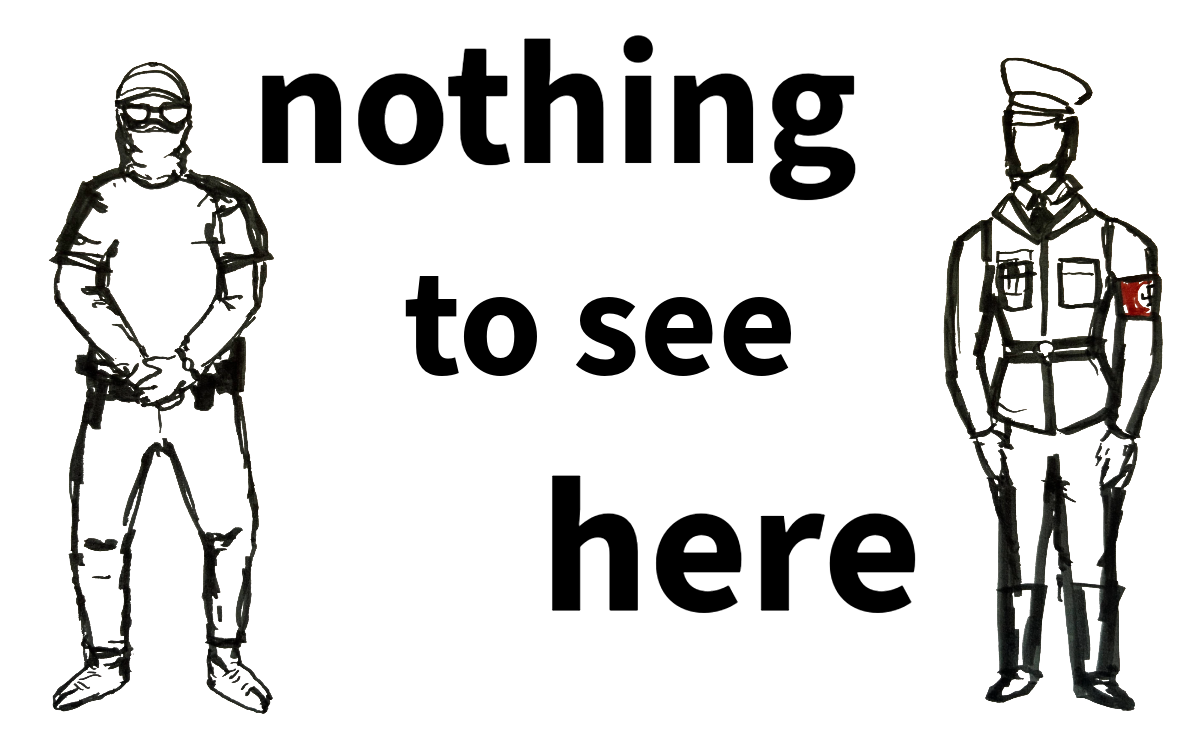
nothing to see here
uniforms, anonymity, and the changing aesthetics of authority

This piece was written after the murder of Renee Good by ICE agents on January 7th, but before the execution of Alex Pretti by ICE agents this past Saturday, January 24th. If you want to send some financial support to Minnesotans, here are a couple online resource directories of organizations, mutual aid groups, and crowdfunding campaigns.
I worked at a school with a uniform policy for years. I know there are valid arguments for school uniforms—many of them having little to do with education itself.1 Some of my students’ parents worried about lightning-quick judgments made by police, and felt that their teenage son had a better chance of being clocked as a mischievous kid rather than a threat if he was wearing a polo and khakis. Schools also claim that uniforms motivate students and create a culture of belonging2, an idea I can understand in theory.
In practice, though, the utopian promise of the school uniform failed again and again. I know of no parent who felt that a school uniform saved them money. Uniforms require frequent laundering unless you own many spare pants and shirts, items that need constant replacing as children grow. Students miss out on instructional time because they are pulled from class or sent home to change. (Also, as with all clothing, options in plus sizes are far more limited, compounding the burden for children who don’t fit into straight-size adult clothes.)
Some proponents of school uniforms argue that they level the playing field, eliminating (or at least concealing) economic and social class differences.3 To that I say: you obviously have not spent even one day inside a middle school. Children are smart. If your clothes don’t belie your family’s economic status, your backpack will—or your phone, or your sneakers, or how often you get your hair done. Uniforms merely relocate class distinctions.
Lately, though, I’ve been thinking less about uniforms as a matter of equity and more about their effect on the individual psyche and their utility to institutions. Whatever hierarchy a uniform claims to eliminate, it creates another: those who enforce it. The people extolling the virtues of uniforms are usually those at the top, and the benefits are largely in service of the organization, in the name of productivity or employee morale. (You can find many dystopian LinkedIn posts and LinkedIn-adjacent sections of company websites dedicated to this idea.)
“By reducing the time spent on choosing what to wear each day, employees can focus more on their tasks […] uniformed employees often exhibit higher levels of discipline and commitment to their duties, leading to improved efficiency and overall productivity within the workplace.” -Total Workwear
Similar arguments are made for military uniforms (“style, appearance and color, as well as insignia, decorations, and so on […] contribute to togetherness, orderliness and discipline, and add to the soldiers’ sense of camaraderie, cohesion, and esprit de corps”)4. But there is a darker side to this argument in matters of law enforcement and war: the anonymity and permission that a uniform subliminally grants. Several studies suggest that wearing military gear emboldens police officers more than their regular uniforms, empowering them to act with heightened aggression (yes, even more than usual).5
ICE agents, notably, do not have a standardized uniform, as most government agencies do. Instead, they’ve developed an ad hoc one: tactical vests, t-shirts, baseball caps, gaiters pulled up over their faces—on occasion, even wearing clothing meant to resemble the uniforms of other officials, like sheriffs’ deputies or corrections officers. (Charles W McFarlane paints an incredible portrait of the current-day ICE officer’s wardrobe in this recent GQ article.) In not wearing an official uniform, in deliberately obscuring their identities, in covering their faces with gaiters6 , ICE agents are asserting something else entirely: the ability to operate outside the law, free from supervision or oversight.
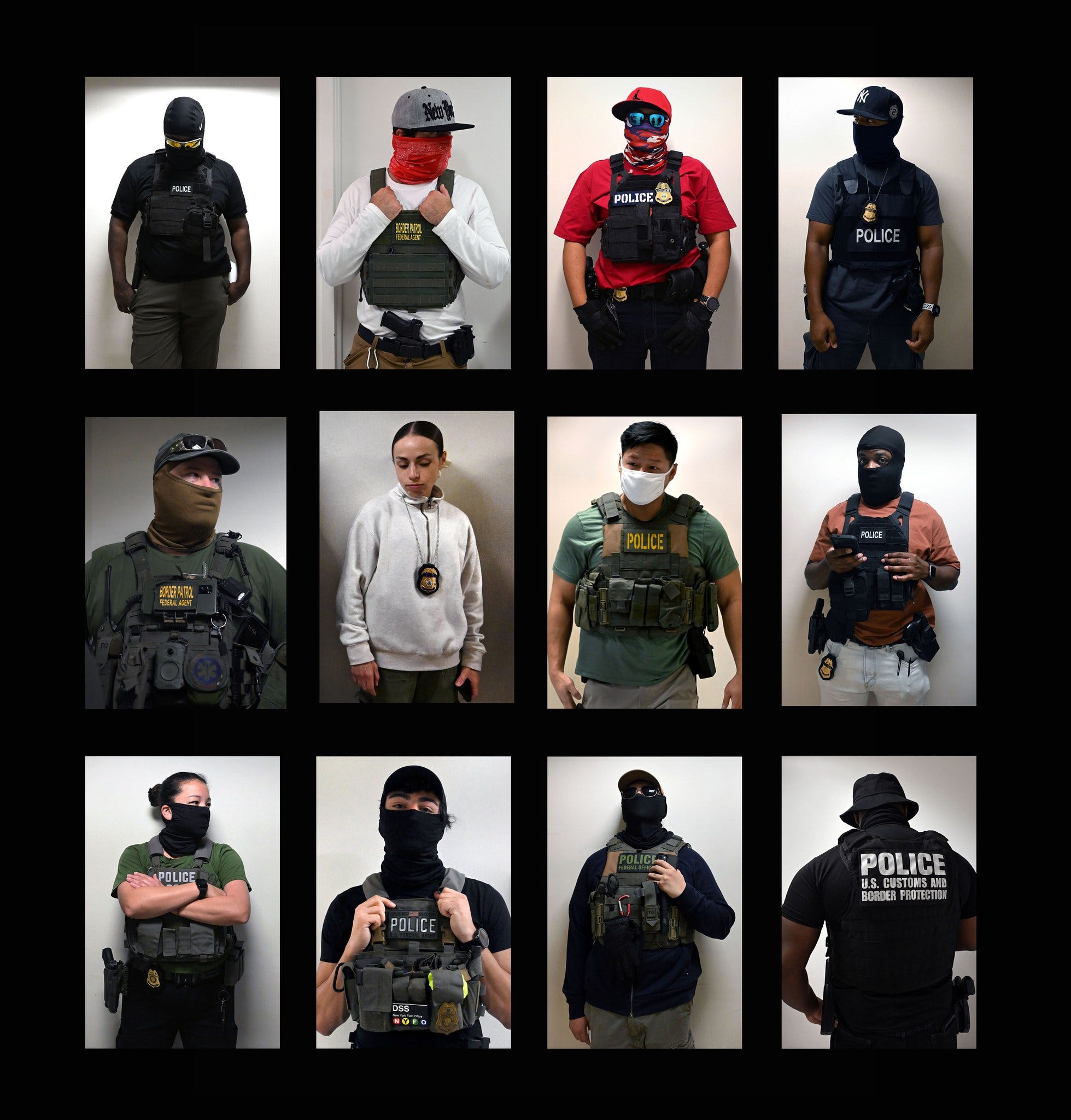
A uniform creates anonymity within a group, but the absence of a standard uniform allows for anonymity within the broader population. That visual ambiguity allows ICE agents to play the tough guy without having to endure public scrutiny from an increasingly concerned population. Many recent ICE actions are not just morally indefensible but openly extralegal, and the lack of an official uniform has in part enabled this escalation to take place in plain sight. It is harder to identify a fascist when they are not required to wear a fascist uniform. The ICE agent who murdered Renee Good had been a deportation officer for over a decade; even his neighbors didn’t know what he did for a living.
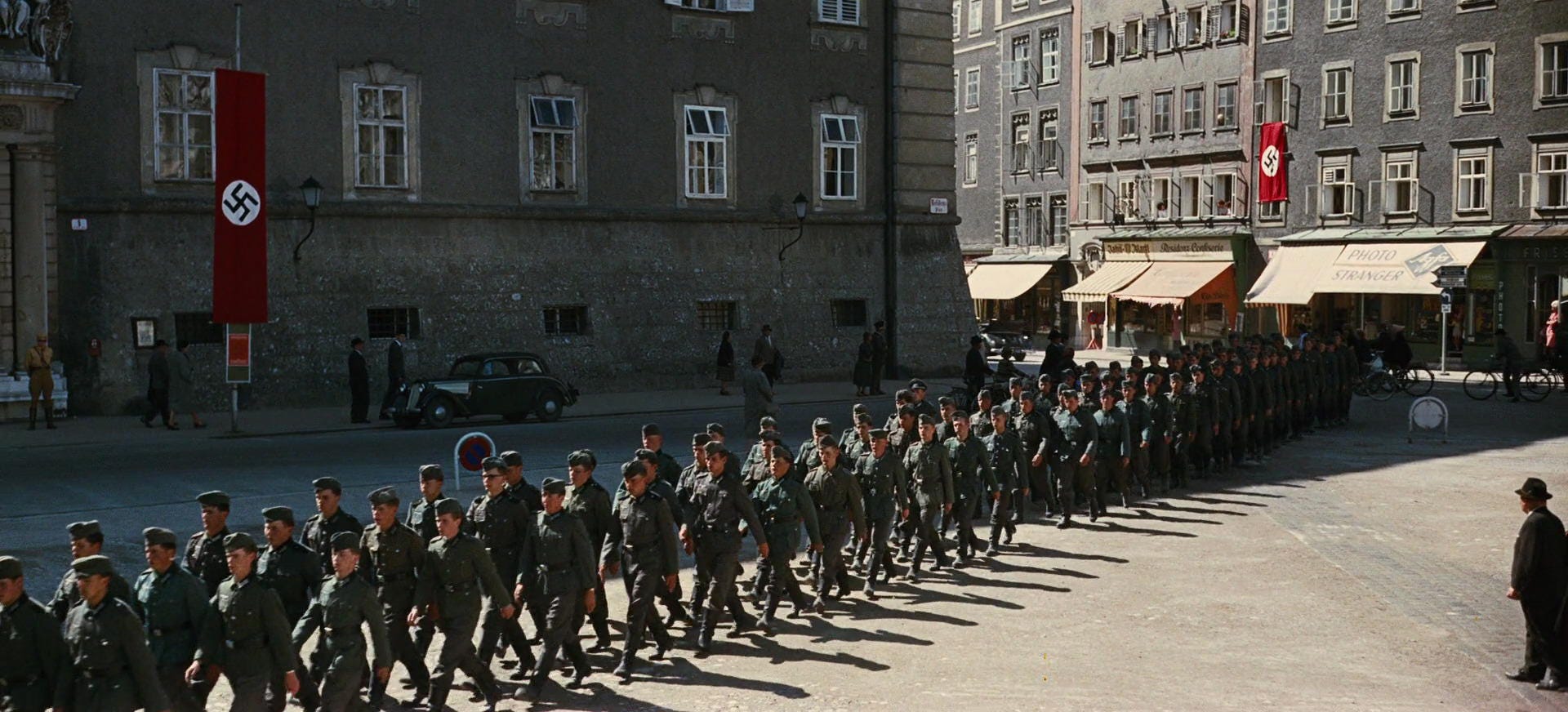
Across school, work, and warfare, uniforms have historically served a common function: to let you act within a role (student, worker, soldier) rather than as an individual, to create distance from the self. Each time I watch my favorite movie (the anti-fascist classic The Sound of Music), I get chills at the sight of the Nazis marching in a diagonal line through Salzburg’s otherwise empty central square, uniforms neatly pressed, arms swinging in unison, indistinguishable from one another but unmistakable as a group. There was clarity in that sartorial demarcation of state-sanctioned evil; it’s the reason that just a single frame of film can evoke so much fear.
Throughout history, uniforms have also served to make power legible. You could see who was acting in the name of the state, and who would be held responsible for it. Today, power is most effective when it cannot be recognized at all. Anonymity does the work that a uniform once did. The fascist state has abandoned the uniform because it learned it didn’t need one.


One very practical argument for at least a temporary uniform—they come in handy in a huge way on field trips—it’s much harder to lose a child at Six Flags when you make them all wear ugly neon orange shirts!)
“Grounded in this perspective, many administrators and policy makers have equated school uniforms with private schools, which are perceived as secure, safe, and orderly places of learning (Huss, 2007)… One major consideration pro-school uniform groups cite is student safety. Past school uniform policies have been introduced as a way to equalize the school culture/setting to support students and reduce gang attire and activity, increase school safety, and decrease clothing theft (Daugherty, 2002; Kaiser, 1985; Stanley, 1996; Zernike, 2002). Thus, from risk-taking perspective, school uniforms are often viewed as a way of mitigating risks to vulnerable populations, including fear of intimidation and discrimination.” -School Uniforms and Student Behavior: Is there a link?
This is such a thoughtful analysis. It’s so insidious, the homemade uniforms that allow anyone to grab people and throw them in a van. Horrific on every level
Wow! I am impressend!